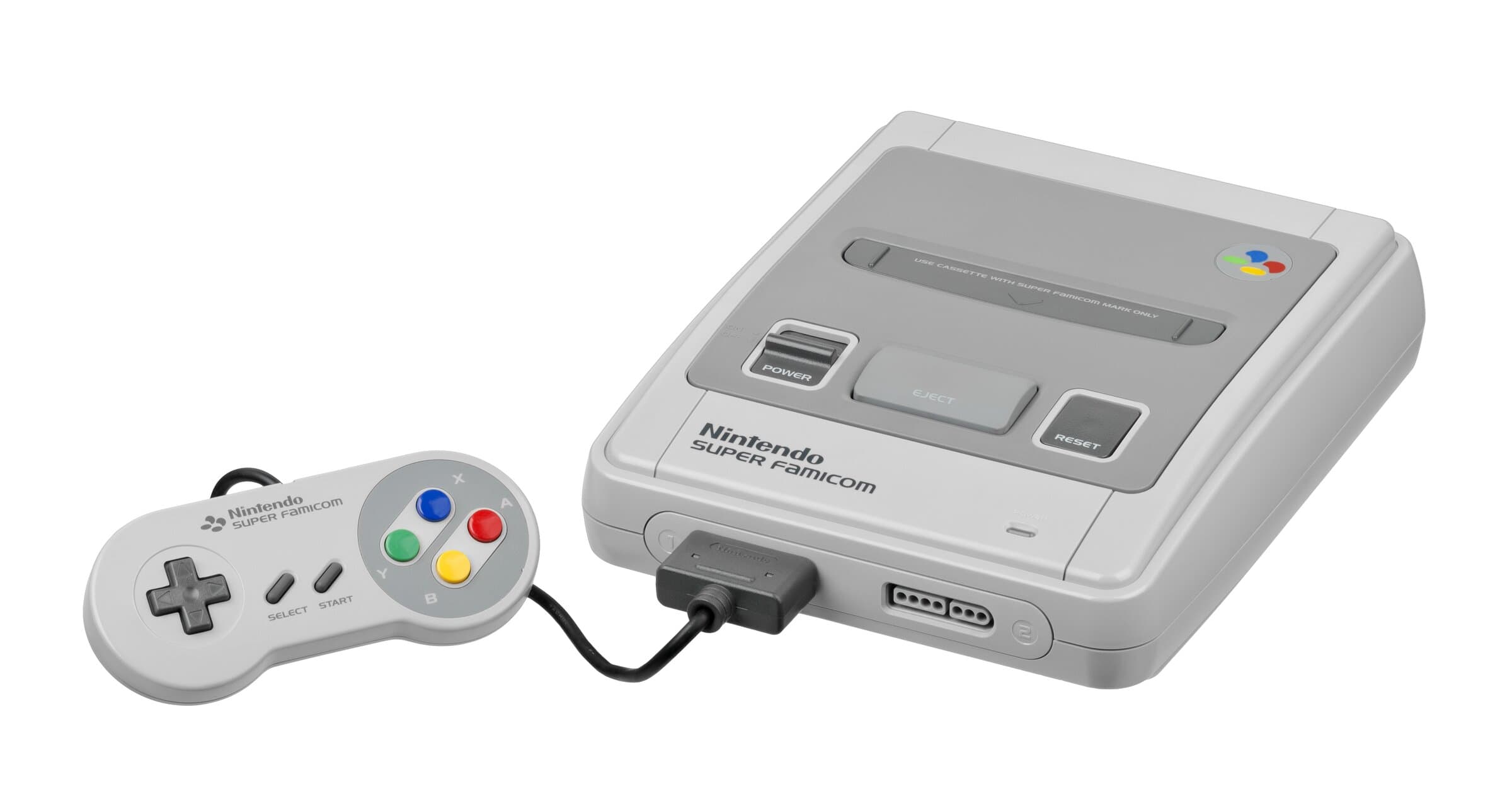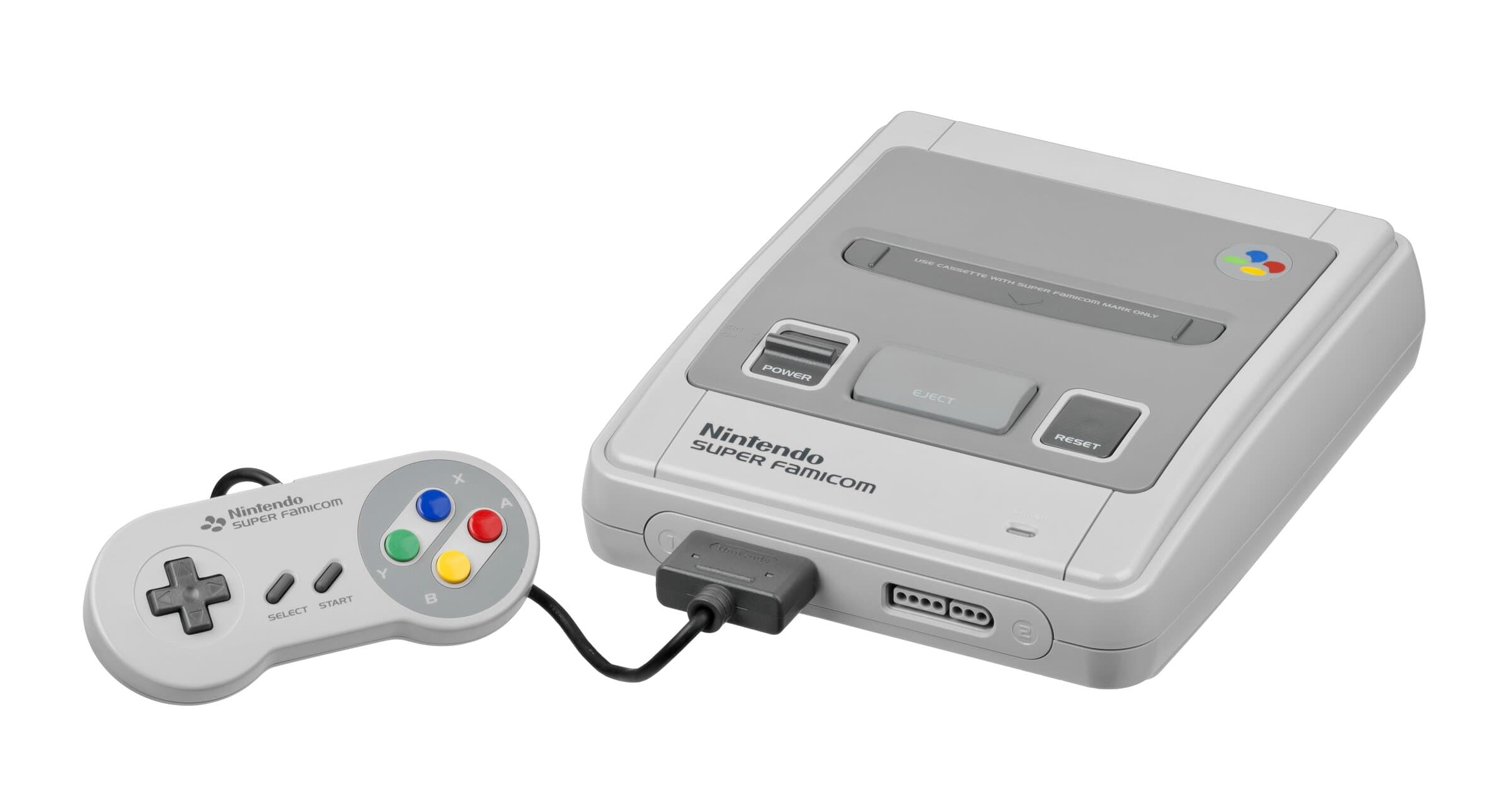
The SNES is the console that arguments about "best library of all time" tend to start at. It launched in Japan in 1990, North America in 1991, Europe and Australia in 1992, and ran in production until 2003 in some territories. Its catalogue is shorter than the PlayStation's, smaller than the NES's, and almost without filler.
What's inside
The SNES uses a Ricoh 5A22 derived from the Western Design Center's 65C816, a 16-bit chip backwards-compatible with the NES's 6502. It runs at 3.58 MHz, which is slow even for 1991, and Nintendo cheerfully shipped the console knowing this. The reason is that the heavy lifting happens in the two Picture Processing Units, which together gave the SNES eight background layers, a 32 KB colour palette, and Mode 7, a hardware affine transform that lets a single background layer rotate, scale, and skew in real time. Mode 7 is what made F-Zero feel like flying, Super Mario Kart feel like driving, and Pilotwings feel like falling.
What it shipped with
The SNES controller is the gamepad blueprint everyone is still copying. Two shoulder buttons, four face buttons in a diamond, the SNES introduced the layout that PlayStation, Xbox, and Switch all still use. The North American console got a slate-grey case with a purple insert. Japan and Europe got the rounder, friendlier "Super Famicom" body. Both run the same software.
The catalogue and the chips
Cartridge slots on the SNES carried more than ROM. They could include enhancement chips that effectively gave the host extra silicon: the SuperFX in Star Fox (rendering polygons the SNES could not draw on its own), SA-1 in Super Mario RPG, DSP-1 in Pilotwings. Each cartridge was a small co-processor, and the platform's most ambitious software lived inside cartridges nobody else could replicate.
The library: Super Mario World, The Legend of Zelda: A Link to the Past, Chrono Trigger, Final Fantasy VI, Super Metroid, Earthbound, Donkey Kong Country, Super Mario RPG, F-Zero, Star Fox, Yoshi's Island. Tighten the list to ten, the worst entry is still better than most of what shipped on its competition.
Why it still matters
The SNES is the bookend of the cartridge era done well. After this, optical media took over for a generation, then died in turn. For the specific blend of long-tail JRPG ambition and Nintendo first-party precision, this is the high-water mark, and the catalogue still rewards the time.