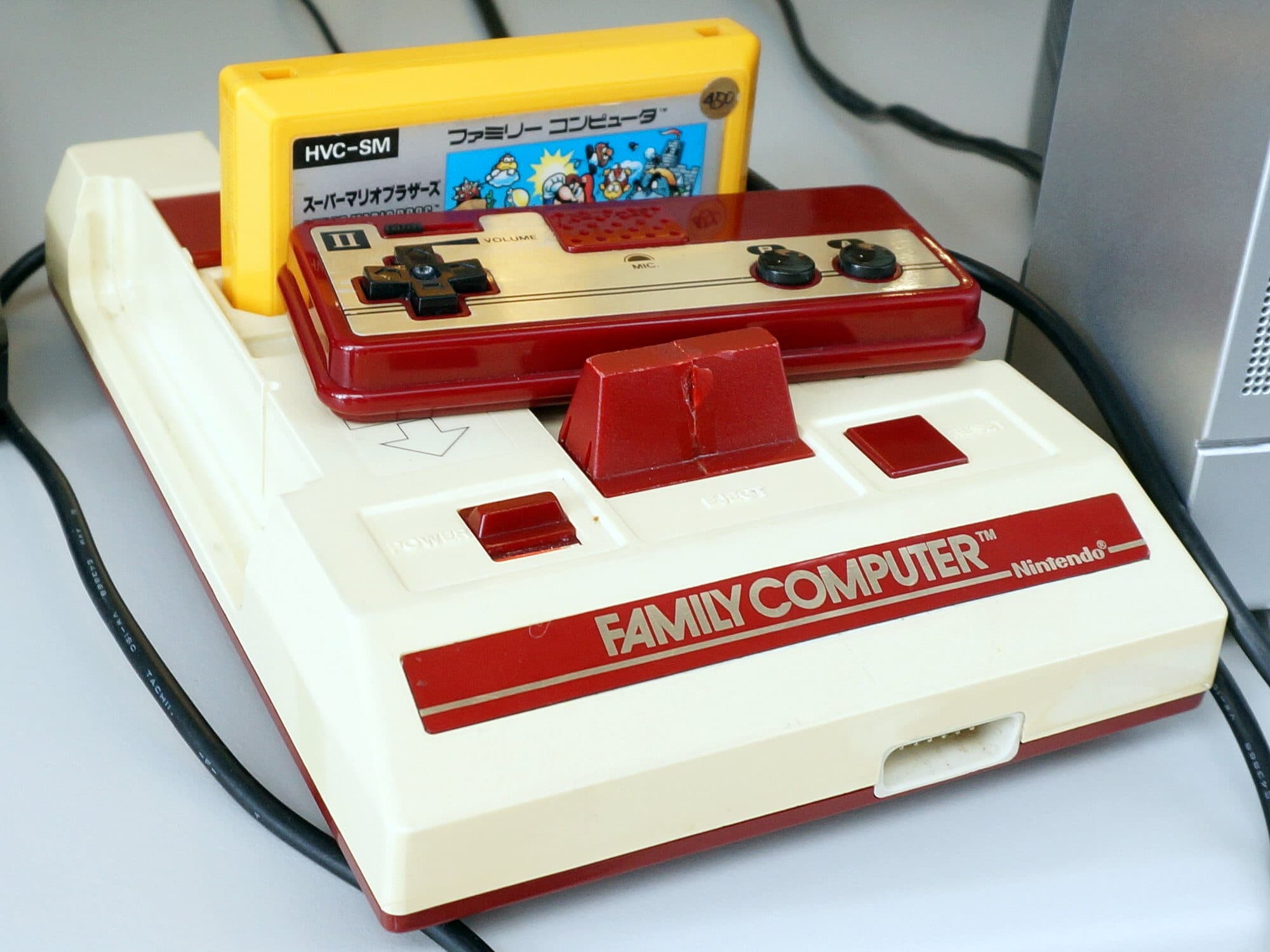
The hero photo on this page is a Famicom, the Japanese version of the NES that Nintendo never sold internationally. The Famicom had a proper microphone in the second controller, two permanently attached gamepads, and a top-loading cartridge slot. It also ran Super Mario Bros. exactly the way the NES did, because they are the same machine in different cases. The Famicom shipped in Japan two years before the NES reached the West, and Super Mario Bros. was the launch title that anchored both.
What it is
A 32-level horizontally-scrolling platformer where you control Mario (or in two-player alternating mode, Luigi) as he runs and jumps from left to right, bouncing on enemies' heads, collecting power-ups, and rescuing Princess Toadstool from Bowser. Every two-dimensional platformer made since 1985 either inherits or argues with the rules this game established.
Why it matters
Super Mario Bros. is a textbook of game design and has been studied as one for forty years. World 1-1 is the canonical example of teaching mechanics through level layout: the first Goomba forces you to discover the jump button, the first ? block teaches you that hitting blocks from below produces results, the first pipe demonstrates the warp mechanic. Nothing is ever explained on screen. Players learn by trying things and noticing what changes.
The game also got the feel of jumping right in a way that most contemporaries didn't, and most successors had to study. Mario's horizontal acceleration ramps over four frames. He turns faster than he moves. His jump apex is higher when held than when tapped. None of this is documented, all of it is felt. Three decades of platformer design has been people trying to recreate that feel.
The catalogue position
Super Mario Bros. was bundled with the NES Control Deck in North America and is consequently the best-selling video game of all time on a standalone basis (~40 million copies). It established Mario as a brand and Nintendo as a software company first and a hardware company second, a positioning the company has never since abandoned.
Worth playing in 2026?
Yes. The whole game runs in about 30 minutes if you know what you're doing, longer if you don't. The Switch Online subscription bundles it; original NES carts are common and cheap (under AU$20 for a bare cartridge, more for boxed). The Game & Watch handheld Nintendo released in 2020 was a single-purpose Super Mario Bros. device and is the most pleasant way to play it.