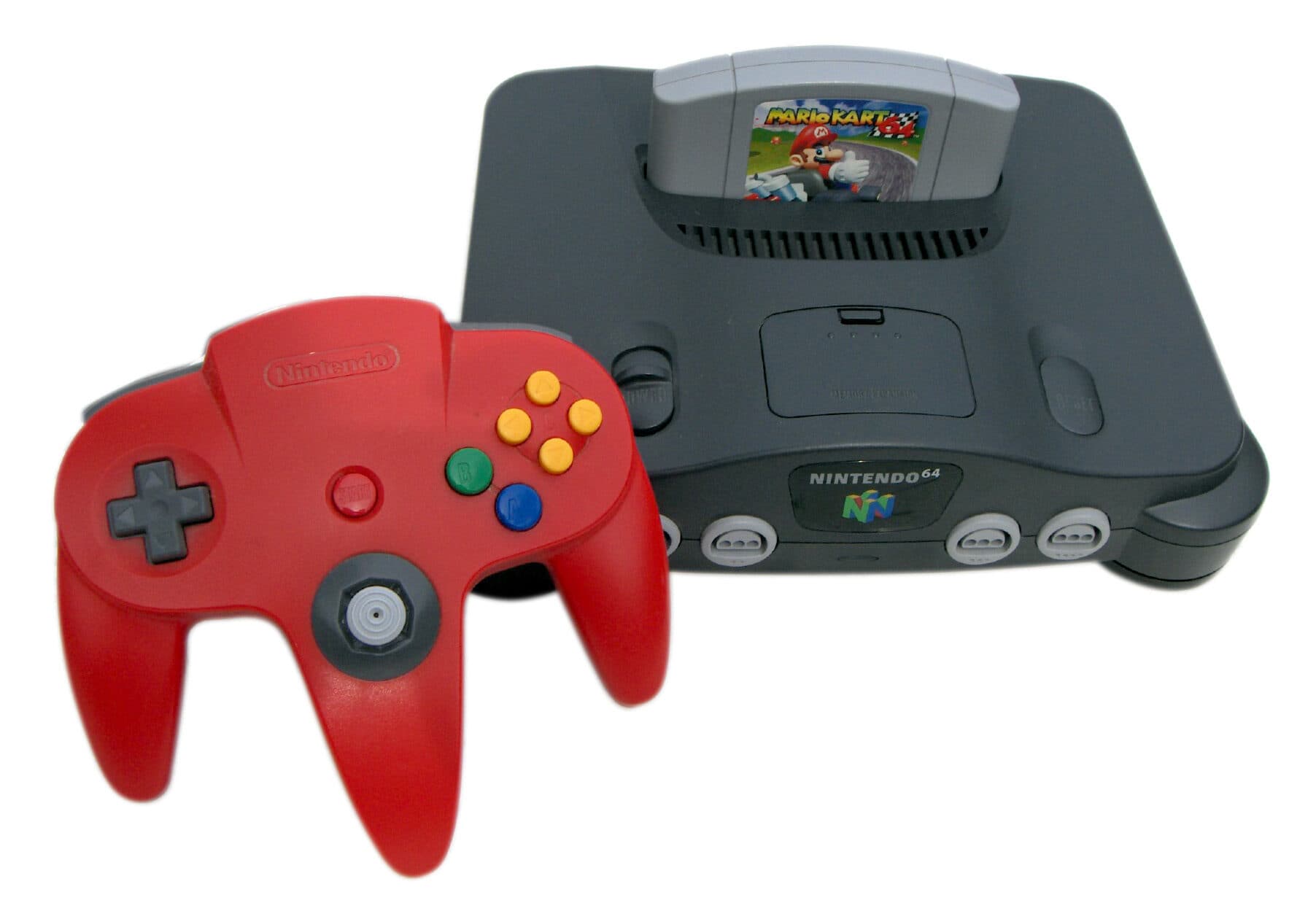
A Nintendo 64 in 2026 is roughly thirty years old. Most surviving units have lived through several owners, several houses, and at least one box-of-childhood-stuff in a parent's garage. The hardware is robust, but caveat emptor.
What you actually want
A clean grey console, a working power supply (Nintendo brand, the brick), an original AV cable, at least one controller with a tight analog stick, and a memory card if you're playing anything with saves. Optional but worthwhile: a transfer pak, an expansion pak.
What you don't want
- A console that's been "tested" but not by you. Sellers will say "powers on" without saying "displays a picture" or "loads games." Three different things.
- A controller with a wobbly stick. Unless the seller has discounted accordingly. The stick wears, replacements are cheap (~$10), but you should know going in.
- A console listed as "boxed" with no photo of the box. It isn't.
- Any "modded" console without details. Could mean a clean RGB mod (good) or a hot-glued region switch by a fourteen-year-old (bad).
Fair price
In Australia, in 2026, a working grey N64 with one stock controller, official PSU, AV cable, and no obvious damage runs $80–$150. Coloured shells (Watermelon Red, Jungle Green, Ice Blue, etc.) command a premium of $20–$80 over grey depending on rarity. Boxed and complete (CIB) goes from $300 upward depending on box condition.
If you see one for under $50 there's usually a reason: incomplete, untested, yellowed, sticker-removal residue. Ask before buying.
Fixable faults
- Dead analog stick → ~$10 part, 15 min of unscrewing. Easy.
- No AV output, plays sound → AV cable is dead, or AV multi-out connector is dirty. Try another cable first.
- Yellowed shell → Retr0bright treatment (hydrogen peroxide + UV). Tedious but works.
- Won't boot at all → 80% of the time it's the AC adapter, not the console. Try a known-good PSU.
Not worth fixing
- Cracked motherboard. Walk away.
- Liquid damage with corrosion on the chips. Walk away.
- Burnt smell on power-on. Walk away.